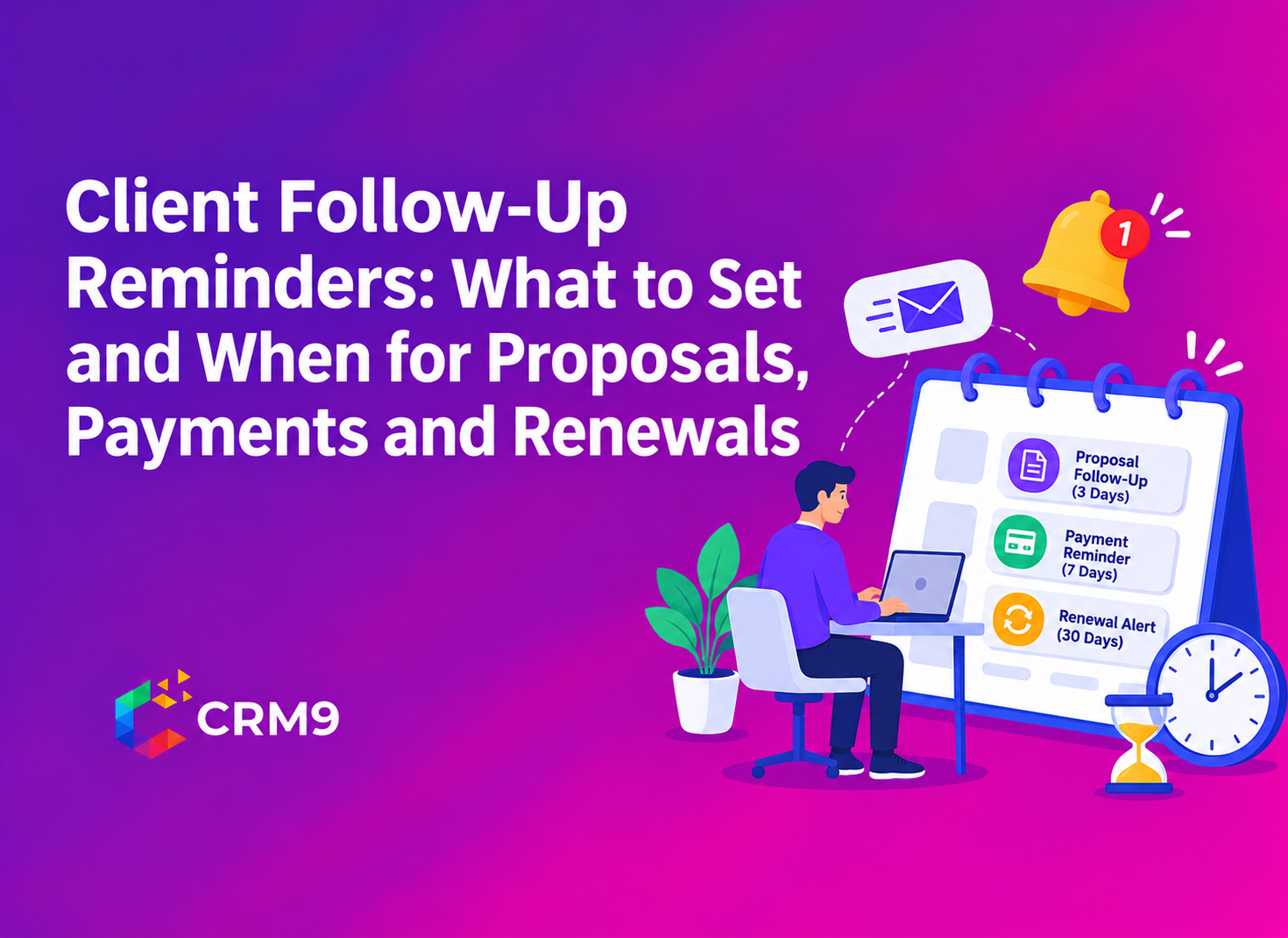
A prospect says, Let me think about it, and you tell yourself you will check in next week. Next week arrives with six other priorities. By the time you call, the prospect has chosen someone else. Nothing was wrong with your offer. Nothing reminded you to follow up.
This guide explains what a follow-up reminder is and why client follow-ups get missed. It lists the client moments that deserve a reminder, shows how to word each one, and explains where reminders should live. It ends with a simple way to keep them tidy. In short, pick a person, an action, and a date, and the rest follows.
What Is a Follow-Up Reminder, and When Does a Client Need One?
A follow-up reminder prompts you to contact a client or prospect at a planned time about a specific matter. It is not a vague nudge to keep in touch. It has a reason, a date, and an owner.
A client needs one whenever you are waiting for something: an answer to a proposal, a payment, a renewal decision, or feedback on finished work. Any time the next move depends on the client, a follow-up reminder protects the relationship from silence.
An example shows the difference. Calling Anita about the proposal on Thursday is a follow-up reminder. Stay in touch with Anita is not, because it has no action and no date.
This kind of reminder depends on someone else’s schedule. You cannot control when the client replies, but you can control when you check in.
Why Do Client Follow-Ups Get Missed?
Most missed follow-ups share the same causes. They are habits, not character flaws.
- The follow-up lives only in someone’s head.
- It sits on a sticky note or in a chat message that scrolls out of view.
- The date was never set, so next week quietly becomes sometime.
- A colleague covers the client and does not know that a follow-up is due.
People often build workarounds, such as a private list just for follow-ups. That works for one person, but it breaks as soon as two people share a client. The fix is a shared record. When follow-up dates sit beside each lead management system and client, anyone covering that account can see what is due. A shared record also helps new team members, who can read the history instead of asking around.
Many people delay a follow-up because they worry about sounding pushy. A dated reminder removes the decision. The task is on the list, so you do it, and a polite check-in with a clear purpose is rarely unwelcome.
Which Client Moments Need a Reminder?
You do not need a reminder for every email. Six moments cover most of what slips. Treat the timings below as starting points and adjust them to your sales cycle.
| Client moment | When to remind | What to do |
| New enquiry | The same day, then again after 2 days | Reply, then check that they have what they need |
| Proposal sent | 2 to 3 days after sending | Ask whether they have questions |
| Meeting or call | 1 day before, and 1 to 2 hours before | Review your notes and confirm the time |
| Payment due | A few days before the due date, then on the day | Send a friendly note, and follow up if it is unpaid |
| Renewal | 30 days and 7 days before | Check for changes and confirm the plan |
| Project milestone | 2 days before | Confirm what you need from the client |
A few notes on the table. For new enquiries, speed counts, because interested people often contact more than one business. Replying within the day shows you are organised. Payment reminders work best when they arrive before the due date, since clients often simply forget. A friendly note a few days ahead avoids an awkward chase later. For renewals, the 30-day reminder leaves time for questions, and the 7-day one catches anyone who has not responded.
Add your own moments as well. A trial that ends, a quote that expires or a contract that comes up for review all deserve a reminder. The table is a starting list, so build on it with the dates that matter in your business.
Meetings and events can live in an events calendar, and reminders can attach to them. For renewals and recurring work.
Our article on managing customer subscriptions explains how to track dates and payments.
How Do You Word a Follow-Up Reminder So It Is Easy to Act On?
A follow-up reminder should answer four questions: who, what, when, and why. If you need to search your inbox before you can act, the reminder is too vague.
| Weak reminder | Stronger reminder (examples) |
| Check proposal | Call Anita about the website proposal and ask whether the budget needs approval |
| Invoice | Remind Mehta Traders that invoice 214 is due on Friday and offer to resend it |
| Renewal | Email Karan about the yearly plan renewal and offer a 15-minute call |
Add one line of context, such as what the client last said. That small note saves ten minutes of searching and makes the call warmer. Keep a record of what happened after each follow-up, because the next reminder should build on it.
Payment follow-ups need the most care. Keep the tone polite and factual: state the invoice, the amount, and the date, and offer to resend it. Avoid blame. Many late payments come from oversight, and a respectful note keeps the relationship intact.
Where Should Reminders Live So You Do Not Miss Them?
A reminder is only useful if you see it. The best place for it is where you already work, next to the record it relates to.
A reminder in a separate app has no context. You see follow up with Anita but not the proposal, the last call, or the amount. A reminder attached to the client record shows all of that at once. Task Reminder attaches reminders to follow-up calls, proposal reviews, project milestones, and client meetings. It ties them to clients, projects, tasks, proposals, and events.
Where the alert lands matters too. Sends reminders inside the app, by email, and to mobile, so a follow-up due while you are out of the office still reaches you.
If several people share an account, a quick note through internal chats and messages tells a colleague that the follow-up is covered, so the client does not hear from two people.
Think about cover as well. If the account owner is on leave, who sees the reminder? Add a backup name to important reminders, so a planned absence does not become a missed follow-up.
Check how the alert reaches you, too. If you read email once a day, an email-only reminder arrives late. Choose the channel you actually look at.
How Often Should You Review and Clean Up Reminders?
Reminders pile up. Left alone, the list becomes noise, and noise gets ignored.
Once a week, scan what is overdue and then complete it, reschedule it with a reason, or delete it. Once a month, look for patterns. Which type of follow-up gets missed most often? Which reminders do people dismiss without acting? The answers show where the wording or timing needs to change.
A team activity log makes this review easier, because it shows what the team actually did and when. End each weekly review by writing down one change that worked. Over a few months, those notes become your own playbook for follow-ups.
Conclusion
Client follow-ups fail when nobody owns the date. List the five client moments that matter most in your business, and set a follow-up reminder for each with a person, an action, and a date. Keep the reminders next to the client’s record, and review them every week. A small routine like this keeps your promises visible, and your clients notice.
Related Reads
- Top Emerging Sales Trends for 2026: What’s Changing in Sales Management
- What Is a CRM Platform? Features, Benefits, Types and How It Works
- What Is a Sales Budget? Purpose, Format, and How to Build One
- Sales Organization Structure: How It Should Evolve as Your Team Grows
- To-Do List or Task Management Software? When a Simple List Stops Being Enough
- What Is Sales Promotion and Why Do Smart Brands Keep Running Them?
- Inside Sales: Roles, Responsibilities, and Strategies for Better Results
- Inside Sales vs Outside Sales: Which Model Fits Your Business Better
- Custom Dashboard Software for Small Teams: What to Track and How to Set One Up
- How to Manage Customer Subscriptions: Tracking Renewals, Payments and Plan Changes
Frequently Asked Questions
Many teams follow up two to three days after sending and again about a week later, adjusted to the client’s decision cycle.
There is no fixed number, but each follow-up should add something useful, such as an answer or a new date, instead of repeating the last message.
Set a dated reminder tied to the client record, so the context is visible when the reminder appears.
Start with a reminder to yourself so the message stays personal and polite, especially for long-term clients.
It should name the client, the action, the date and one line of context.