
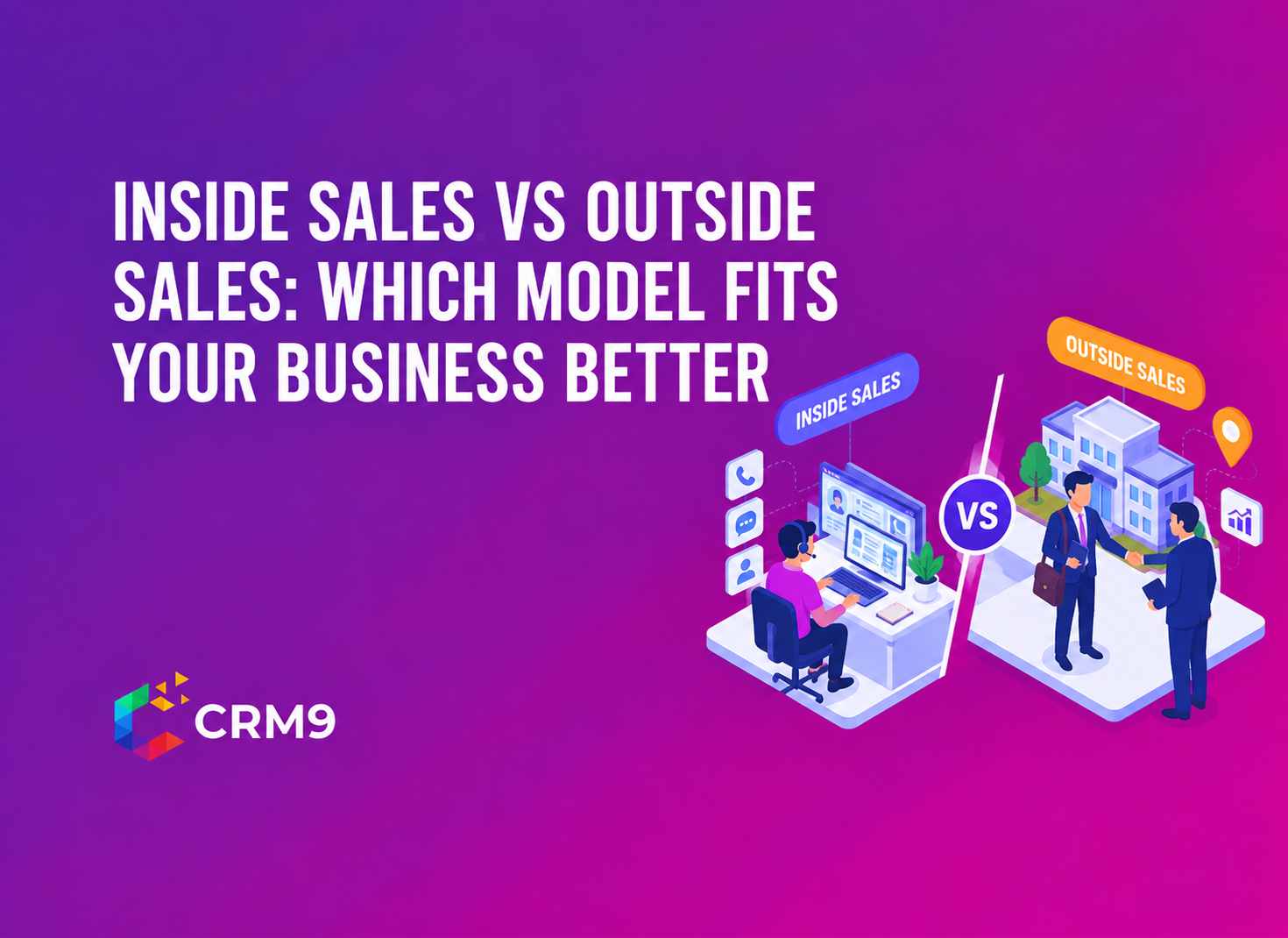
Choosing a sales model affects how a business reaches prospects, manages customer relationships, and uses its sales budget. Some customers prefer quick online meetings and regular digital communication. Others expect face-to-face discussions before making a significant purchase.
This is where understanding inside sales vs outside sales becomes important. Both approaches aim to generate revenue and build customer relationships, but they differ in how representatives engage with prospects, organise their work, and manage sales opportunities. The right choice depends on your product, target audience, deal value, sales cycle, and customer expectations.
What Is the Difference Between Inside Sales and Outside Sales?
The short answer to inside sales vs outside sales is location. Inside sales happens remotely through calls, email, chat, and video. Outside sales happens in person, at the customer’s office, shop, or site. Most of the other differences, such as cost, speed, and deal size, follow from that one point.
Many articles on inside vs outside sales stop there. The table below goes a little further, and you can use it as a quick reference.
| Factor | Inside sales | Outside sales |
| Where selling happens | Phone, email, chat and video | Customer sites, events and meetings |
| Typical sales cycle | Shorter | Longer |
| Typical deal size | Small to medium | Medium to large |
| Cost per rep | Lower, because travel is limited | Higher, because of travel and time on the road |
| Prospects handled in a day | Many | Few |
| Relationship style | Frequent, shorter contact | Fewer, deeper meetings |
These are tendencies, not laws. A rep selling a complex product by video can run a long, high-value cycle, and a field rep selling simple products can close quickly.
What Does Inside Sales Mean?
The inside sales meaning is selling from an office or home workspace using digital channels. Reps qualify leads, run demos and close deals without travelling. If you want the full picture of titles and daily duties, read our guide on what is inside sales.
What Is Outside Sales and How Does the Work Look?
What is outside sales in practice? It is selling that involves travelling to meet buyers in person. The outside sales meaning covers reps who visit offices, factories, shops, and events, run live product walk-throughs, and often negotiate larger deals in the room. Their calendars revolve around routes, appointments, and long relationships.
The outside sales meaning also reaches dealer visits and trade shows, not only customer meetings. Industries such as medical devices, industrial equipment, real estate, and large business services commonly use this model. Their buyers often want to see, touch, or inspect something before they sign.
How Can CRM Software Coordinate Both Sales Teams?
Inside and outside sales teams often work with the same prospects but interact with them through different channels. Without shared records, one representative may not know what another has discussed with the customer.
Customer relationship management (CRM) software helps centralise customer information and make sales activities more visible.
- Lead management: Keep prospect information organised and track opportunities as they move through the pipeline.
- Client management: Maintain customer details and interaction history so representatives can prepare for discussions.
- Task management: Assign follow-ups, schedule next steps, and clarify responsibility for each activity.
- Proposal management: Organise proposals and maintain visibility into outstanding commercial discussions.
- Custom dashboards: Review sales activity and performance information to identify opportunities that need attention.
For example, an inside sales representative may qualify a lead and arrange an on-site meeting for a field representative. Shared records help the field representative understand the prospect’s requirements before arriving.
After the meeting, the representative can record the outcome and assign follow-up actions. The inside sales team can then continue the conversation without asking the customer to repeat information.
The exact capabilities available depend on the software and its configuration. Businesses should evaluate their requirements before selecting a CRM solution.
Which Sales Model Costs Less?
Inside sales generally involves lower travel-related expenses because representatives conduct most customer interactions remotely. Outside sales can require additional spending on transport, accommodation, meals, event attendance, and other field activities.
However, total sales cost depends on more than travel.
Businesses should consider the following expenses when comparing the two approaches:
- Employee costs: Salaries, incentives, training, and recruitment expenses can vary by experience, industry, and location.
- Technology: Inside sales teams may need calling systems, video conferencing, sales engagement tools, and CRM software. Outside sales teams can also use these tools, along with mobile access and territory-planning capabilities.
- Travel and field expenses: Outside sales may require a larger travel budget, particularly when customers are geographically dispersed.
- Cost of acquiring customers: Consider how much the business spends on sales activities to acquire a new customer, including the time invested by representatives and other supporting teams.
- Deal value and conversion rate: A more expensive sales process may still make commercial sense if it helps close larger deals or improves conversion among valuable prospects.
For example, a company selling an affordable subscription may find that remote selling is commercially sensible. A business selling specialised machinery may justify on-site visits because customers need detailed assessments and demonstrations before purchasing. The goal is not simply to choose the cheapest model. It is to choose a sales process whose cost is justified by its results.
When Should a Business Choose Inside Sales?
Inside sales can be a suitable option when customers can evaluate and purchase a product without regular in-person meetings.
Consider this approach when:
- You sell digital products or services. Software subscriptions, online services, and other remotely delivered solutions can often be explained and demonstrated online.
- Your target audience is geographically dispersed. Remote communication allows representatives to contact prospects across regions without travelling for every meeting.
- Your sales process is repeatable. Businesses with standard qualification steps, product demonstrations, and proposals can organise these activities efficiently through digital channels.
- You need to manage a high volume of leads. A structured process and appropriate tools can help representatives prioritise and follow up with multiple prospects.
- You want to control travel expenses. Remote selling can reduce the need for routine customer visits, although other sales costs remain.
For example, a growing SaaS business may use inside sales to qualify enquiries, demonstrate its platform, and manage subscription opportunities. Representatives can focus on customer requirements while tracking activities through a shared CRM system.
Inside sales may be less suitable as the only approach when the product requires physical inspection, extensive on-site consultation, or frequent in-person relationship management.
When Is Outside Sales the Better Fit?
Outside sales may be more appropriate when face-to-face engagement adds meaningful value to the buying process.
Businesses should consider it when:
- Products require on-site demonstrations. Customers may need to see equipment in operation or evaluate a product within their own facilities.
- Purchases involve complex requirements. Site assessments and detailed discussions can help representatives understand technical or operational needs.
- Deals involve several decision-makers. In-person meetings may help coordinate discussions among stakeholders when the buying process is complex.
- Personal relationships influence purchasing decisions. Some industries place considerable value on direct interaction and long-term relationship development.
- Sales opportunities justify the additional expense. High-value contracts may support the time and travel required for customer visits.
For example, a company selling industrial machinery may need representatives to inspect customer facilities, discuss installation requirements, and coordinate with technical specialists.
Outside sales is not automatically the better choice for every high-value deal. Businesses should determine whether a physical visit improves the customer’s understanding, confidence, or ability to make a decision.
Can a Business Combine Inside and Outside Sales?
Yes. Many businesses can benefit from a hybrid sales model that combines remote engagement with in-person meetings.
This approach allows teams to use digital communication for routine activities while reserving customer visits for opportunities where face-to-face interaction adds value.
A hybrid sales process might work like this:
- Generate and qualify leads remotely. Inside sales representatives contact prospects, understand their requirements, and assess their potential.
- Identify opportunities that need a visit. Complex requirements, site assessments, or important stakeholder meetings may justify an in-person discussion.
- Assign the opportunity to the appropriate representative. The team agrees on ownership and shares the information already collected.
- Conduct the meeting and record the outcome. The representative documents customer feedback, commercial discussions, and agreed next steps.
- Continue follow-ups through the most suitable channel. The team uses calls, emails, video meetings, or further visits as needed.
A hybrid model works best when responsibilities are clearly defined. Without shared records and agreed handover rules, representatives may duplicate outreach or leave customers waiting for updates. Businesses should also review whether the additional coordination improves conversion rates, customer experience, and overall sales efficiency.
How Should You Decide Which Sales Approach Fits Your Business?
The best sales model depends on your customers, product, sales budget, and sales process. Instead of choosing based on industry trends alone, assess the factors that directly affect how your customers buy.
Ask these questions before making a decision:
- How do customers prefer to interact?
Review whether prospects are comfortable with digital demonstrations or regularly expect in-person discussions. - Does the product require physical assessment?
Equipment, industrial products, and certain technical solutions may need on-site evaluation. - What is the typical deal value?
Consider whether the expected revenue and profitability justify the time and expense associated with each sales approach. - How complex is the buying process?
Multiple stakeholders, detailed technical requirements, and lengthy negotiations may influence how representatives should engage customers. - Where are your prospects located?
A geographically dispersed audience may be easier to serve remotely, while concentrated customer territories may make field visits more practical. - Can your team manage a hybrid process?
Combining both approaches requires shared customer records, clear ownership, and coordinated follow-ups.
Once you have assessed these factors, test the approach with a defined customer segment. Track conversion rates, acquisition costs, sales cycle length, and customer feedback before expanding the model.
Conclusion
Inside sales vs outside sales is not simply a choice between working remotely and meeting customers in person. It is a decision about how a business can engage prospects effectively while balancing customer expectations, operating costs, and sales outcomes. Inside sales can suit businesses that sell remotely delivered products, manage high lead volumes, or serve customers across multiple locations. Outside sales can be valuable when on-site demonstrations, complex requirements, and face-to-face relationship building influence purchasing decisions. For some businesses, combining both approaches offers the most practical solution. By defining clear responsibilities, tracking meaningful sales metrics, and maintaining shared customer records, teams can choose a model that supports sustainable growth.
Related Reads
- Top Emerging Sales Trends for 2026: What’s Changing in Sales Management
- What Is a CRM Platform? Features, Benefits, Types and How It Works
- What Is a Sales Budget? Purpose, Format, and How to Build One
- Sales Tracking Metrics: What to Track and Why They Matter
- Sales Organization Structure: How It Should Evolve as Your Team Grows
- To-Do List or Task Management Software? When a Simple List Stops Being Enough
Frequently Asked Questions
Most start-ups begin with inside sales because it costs less and tests the market quickly, then add field visits for larger accounts.
Yes, in small teams, as long as the calendar separates call days from visit days.
Often yes, since their deals are larger, but pay depends on the company, product and city.
Usually, because travel costs are lower, but a deal lost for lack of a visit can cost more than the trip.
It keeps leads, customer records, quotes and follow-ups in one place, so both teams see the same information.